Interview with Sean Carnegie
27 September 2022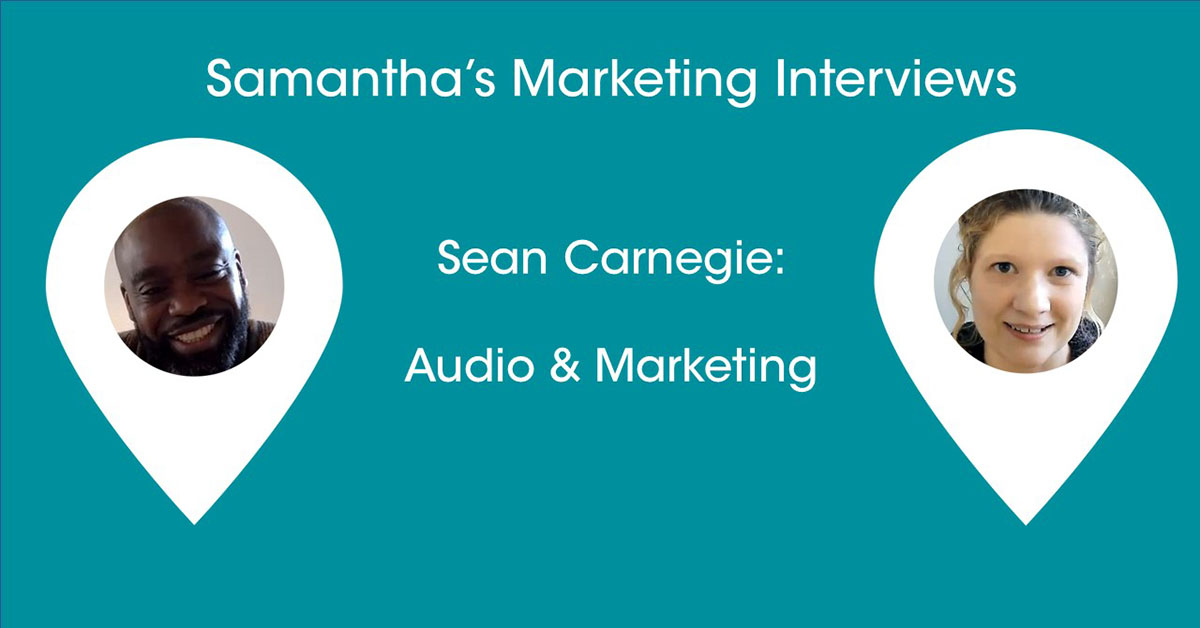
Samantha interviewed Sean Carnegie, Managing Director of the audio creative agency, Radioville. Sean revealed some amazing facts about audio, the latest innovations in the industry, and how it can help your business to succeed. Did you know, for example, that different ads can be broadcast to podcast or radio listeners, in real time, based on their location or even their habits?
They also spoke about reasons why audio consumption might be on the rise. A little hint: just think about how often you listen to podcasts while doing the dishes or driving your car. Audio clearly shouldn’t be dismissed in your marketing plans. But there are some things you need to determine in advance. For example, do you know what your brand’s audio identity is? Do you know whether you should sponsor an existing podcast or create your very own? Have you ever heard of actionable audio ads? These questions and many others are answered in the by Sean below.
Sean’s links:
Watch the video here or read the transcript below if you prefer.
Samantha Tonge: Hello again, everyone. It's Samantha Tonge at Labrakita Marketing with another expert interview. This is something I've never gotten involved with myself, personally, so I'll be interested in this one. We've got Sean Carnegie here, who is going to be talking about how you can use audio in marketing. Sean, can you introduce yourself, please?
Sean Carnegie: Well, gladly. Thank you for having me, Samantha. As you said, I'm Sean Carnegie, Managing Director at Radioville. So Radioville is an audio creative agency that specialises in helping brands and businesses raise their brand awareness and gain more customers through the power of audio advertising. And that audio advertising can be radio, it can be online audio, Spotify, audio in podcasts or smart speakers, generally speaking.
Samantha: Yeah. So, I guess these things have expanded a lot, because back in the day... my background is business-to-business. And we didn't do a whole lot of radio advertising, because it just didn't hit the right market. But these days, there are so many different podcasts and, like you say, Spotify, that are targeting people. And I imagine there'll be podcasts about business-to-business subjects as well, that are now of interest.
Sean: Exactly. But also, because radio, well, audio has evolved to such a point, and data capture has evolved to such a point, that B2B brands can now identify the type of person that they want to speak to. And businesses and people buy from people. So whilst you're a B2B marketer, you're trying to speak to a decision maker, and that decision maker is a person, who has media consumption habits, and will listen to various radio stations. So we've done numerous campaigns for B2B brands, because we've been able to target their core demographic, and plan a media strategy and a creative around that.
Samantha: Yeah, okay. That's really interesting, because data has really transformed the market, especially in the B2B space, I feel. Because… and that's the same with TV as well. B2B brands are starting to do more advertising on TV, because with fibre connections, and Sky apparently can do it as well, where they go and different people in different households will actually be given different ads.
Sean: Within the same household.
Samantha: Oh, now it's within the same household? Wow.
Sean: It's called the Sky AdSmart. So yeah, if they've got the data, and they understand that you might have two Sky boxes in two different rooms, those boxes might be served different ads. I think. That's what I've been told anyway. TV is not my expertise.
Samantha: It sounds very similar to how data and all the more information we have these days, it's kind of changing the market and how we are better able to target.
Sean: Yeah, it's just that programmatic advertising is now available and has been available on radio for ages, you know. Because we've now got that data. But in addition to that, you can create programmatic creative as well. So whilst you could, in real time, on radio stations, serve different creatives. Now, because most people, or at least a significant amount of people listen to radio not through a little box in the corner of a room but on their phone, or on their laptop, or perhaps their smart speaker. So, the media owners now have lots of data, and they can, in real time, serve different creatives to different demographics. So not only can the advertising space be bought on a programmatic basis that's highly targeted to your target audience, but the creative that is served to different people can be spoken in real time.
So you and I could be listening to the same radio station, at the same time. And the clever wizardry that goes behind this technology will know that you're up in Edinburgh, and I'm in London. It might also know that I support Tottenham Hotspur, while you support Glasgow Rangers, for example. And they will serve us different commercials. But I'd argue that with a bit of data mining and understanding of your target demographic, not just the location, but your spending habits can be incorporated into there as well; your purchasing habits, and all that kind of stuff could be factored into the creative. So it can be really, really targeted. Yes, it does sound a little Big Brother-esque at times. But yeah. You know, I suppose, when used correctly, it can be used to really engage with your end-user.
Samantha: Yeah. Exactly. I mean, people aren't going to listen to adverts they're not interested in. That's really interesting. And I guess most marketers will be familiar with doing that with email, you know; different targets getting different versions of the newsletter that goes out or whatever. But that's really interesting that you can do that in radio as well, or audio.
Sean: Yeah, you know, there's... and I would say this, because I'm biased, and I LIVE audio, but there's nothing that I can think of that another channel can do that radio can't. So if we're talking about building brand awareness, changing perceptions of a brand, or tactical advertising, where you're driving a certain response, talk about programmatic, all of those things that you could do with TV and digital marketing are also available to brands using audio, with the added bonus of radio, audio, and sound being quite an emotive thing, you know. So there's another layer of human connection there that is sometimes missing with some of the other channels.
Samantha: Yeah, and it's good. I think also, people remember messages better if they receive it in different formats. So if they've read it, they've heard it, and they've seen it. It's going to start to stick.
Sean: Yeah, yeah, yeah. This is it. And we've seen that with loads of our clients. What they tend to do is have a 360-marketing campaign, where they phase the different elements. So they might start with TV and out of home, turn that off, and then have a period of time when they're in the papers and in print, and then bring in radio to amplify everything that has gone before. And because audio…, I think this is still true today. So according to the last research that was done, you could buy twice your audience per pound spent on radio than you could with the next best alternative. So it's really cost-effective. It is not as expensive as TV. So what brands tend to do is go big on TV for a period of time. And then, to achieve the halo effect, and an amplification effect, they then continue on radio or then engage radio afterwards. And it shines a spotlight on the TV ad, that's gone before, and continues to build that reach.
Samantha: That's really interesting. I'm really starting to get ideas going in my head: "Oh my God, how could I use that?". I'm sure that other people watching are as well. That's... okay, wow. Okay. So, yes, just to recap a little bit. You can get really, really targeted. And that's really important: understanding your audience. And that is step one, before they even go to you, because otherwise, they won't know how to target. But it comes back to what I always say to clients: “First thing you need to know is to understand your audience, what the message is, or what the messages are per segment.” So that you can use audio in that way to target correctly. And yeah, like you said, it's another cost-effective channel, another way to get your message across. And I guess, because people are busy as well. Although I don't know what the data on this is, but I guess another benefit is that people are able to listen to audio, when they wouldn't be able to consume other media. So if they're driving, for example, is that quite common?
Sean: Yeah. There was a piece of research done. I forget who it was by, but it's made that point and reaffirmed that the benefit of radio and audio is that you can actively be engaged in another task while consuming it. And this makes it unlike any other channel, because it's difficult to read a newspaper whilst driving, you know.
Samantha: Yeah, you definitely shouldn't do that.
Sean: Yeah, because most of the other channels involve using your eyes. And, you know, it's difficult for you to have your eye on something else, while you've got your eye on the advertising channel you're looking at.
Samantha: And I find, increasingly, people and target audiences have become so busy. Especially in my sub sectors: technical, industrial-type people are overwhelmed, partly because of the skill shortage, which is really hitting those sectors at the moment. People are just so busy, and they don't have time. So I think that's another thing to consider. And is there...? I don't know if there's data on this, but is that showing up? I know I've listened to a lot more audio than I used to, and not as it is broadcast, personally. I don't know. I don't know if I'm unusual there. Is there research suggesting that audio consumption is going up? Including podcasts and that kind of thing.
Sean: Yeah, podcast listening has massively increased over the last year and a half. I don't have the exact number, I just know that it's on the rise. Likewise, with commercial radio listening. I think in lockdown when there were so many more people working from home, they were having the radio on in the background, what have you. So radio listening went up. And I think with podcasts... There's just so much content out there, really engaging content.
Samantha: Some really great, quality stuff as well.
Sean: And podcasts offer a fantastic opportunity for brands, for three main reasons. There's your three main opportunities. The first is that you've got the opportunity to sponsor a podcast. So you find a podcast genre, or genres that you think are likely to resonate with your target audience, and you sponsor that podcast. Or you can advertise within podcasts as you would do with radio output. And then the third option, which is the really exciting one is that you can produce your own content as a brand. Actually, not too long ago, we worked with a record label, and their objective was to encourage people to discover the back catalogue or some of their older recording artists. So we put together a podcast series. It was co-produced with a couple of production companies. And it was produced by this record label. And within it, we were able to showcase some of the historic tracks, showcasing women. It was showcasing fantastic women in music, throughout the ages. And these women came on and they spoke about the artists that they loved. And we played snippets of the tracks, which encouraged listeners to discover artists that they hadn't heard before, or tracks that they hadn't heard before. So that was all good. And that was purely done by a single brand. It was produced, funded by, and with the brand itself. So yeah, podcasts are increasingly becoming a prominent marketing channel for brands.
Samantha: I know a few people that have started their own podcasts. And although, I know one of them is incredibly successful, I'm not sure about the others. So I guess, if you're going to do it yourself, you need to know what your objectives are. What exactly you want to achieve with it, right? Because I guess that's the most expensive option, producing it yourself. Therefore, you need to know exactly why you're doing it.
Sean: Yeah. But there is a problem, as long as the marketers view it as a branding exercise, rather than a direct response, you know. Like, for example, with this record label. They understood that it was unlikely that it would lead to direct increases in revenue in the short term. Their main goal was: "Here is this record label. Aren't they amazing? They've got so many awesome people on their roster. They're a champion for women. They celebrate female artistry. That's a brand that I want to be a part of. That's a brand I want to engage with." So it was more of a brand exercise, brand consideration, a brand positioning exercise rather than revenue generating.
Samantha: Yes. And that's something that is slightly different between B2B and B2C, but a lot of what we are talking about is similar with both. There's been a lot of research done that concludes that you need to, I mean, we all need to think about the long-term as well as the short-term. There's a short-term lead generation-type of advertising, marketing, etc. And then there's the long-term, brand building stuff that you need to do as well. The difference is, in B2B you should put in about fifty-fifty. This is what you should put in, in terms of what you invest, essentially. In B2C, that's even more skewed towards brand building-type work. So yeah, it definitely makes sense that it's more about building that brand up. But I guess you still need those listeners. So it has to be something that people will want to listen to.
Sean: Obviously. Yeah. There's no point telling a brand story or position the brand to an empty room. And we try and stay away from that in our agency. Yeah.
Samantha: Yeah. But if you've got some knowledge in your business that your target audience or target audiences are going to be interested in, then you’ve probably got to use it. We talk a lot about blogs, about... you know, that's your blog content, that's your PR content, etc. I guess it's potentially a podcast content then as well.
Sean: Yes, I think it's an exciting time with audio. I think there's, as we've spoken about many a times, a screen fatigue and all of that. There is a drive away from screens to a certain extent, and there's an increase in, and a move towards voice activation, audio, and sound. So it's an exciting time for brands, because you can now, and this would be really interesting to some of your listeners, you can now produce actionable audio ads. So if you're listening to radio, or you're listening to music, like Spotify, on your smart speaker, and it's got advertising, you can now produce adverts that listeners can respond to in real time. So for example, I'm listening to Heart A Feminist, say, through my smart speaker. And if I hear an advert for a car that I like the sound of, I can say to Alexa: "Alexa, open up Ford Mustang." And then it will take me down the customer journey, a funnel, where it will ask me questions, which I will respond to and then I'll book a test drive.
Samantha: Oh wow. And I guess more and more people are getting this technology in their homes, they're becoming more comfortable with it. And also, you mentioned during lockdown people working from home. I think moving forward, that's not really going to completely change. Some people are moving to hybrid models, but most office-based workers are going to be doing at least some element of working from home from now on. I don't think that's ever going to go completely rewind. So I guess, over the longer term, this is going to be something to consider.
Sean: Yeah. I don't know what will happen in terms of the go-back-to-the-office situation. But yeah, I think there's a mix, isn't there? There are some agencies that really want everyone back in the office, because they want the culture, what have you. I think like you said there's a talent shortage. So I think those really desirable candidates for jobs and vacancies, they'll be able to dictate whether or not they want to go back to the office, or how much of their time they want to spend at home and how much they want to go into the office.
Samantha: I guess it comes back to target audience again. Who it is you're talking to and whether they are a more forward-thinking type of business, and where there is that skill shortage as well. I know, my sector, so engineering for example, is really struggling and construction is also really struggling with skills shortage.
Sean: Yeah. The same is true in advertising agencies. There's a bit of a shortage on high-end skill. Yeah.
Samantha: So, I guess that's another thing to think of. If your audience... Again, it comes back to having time, isn't it? As well as, I guess, the potential for working from home. There are lots of things in business-to-business anyway. Business consumers are kind of different again. But yeah, they're all sorts of interesting things to consider. Yeah, yeah. So yeah, like I said, I've got so many ideas now. I'm probably going to be on the phone to you within the next six months: "Sean..."
Sean: You know I love audio. I could talk about the power of audio and how great it is for brands all day long. So whenever you fancy a chat, Samantha, I'm always here.
Samantha: So is there anything else, in terms of audio, that you don't think we've covered? You know, anything that marketing professionals or other businesses that do their own marketing ought to think about?
Sean: Maybe having an audio identity. So, you know, we're all familiar with visual brand guidelines. And I think, increasingly, brands are becoming more aware of the need to have audio brand guidelines. Especially if their marketing involves multiple channels, where there's audio and visual, or just audio. To ensure consistency across all communications, it makes sense to codify what your brand sounds like. And that's not just in terms of your tone of voice, as in the language you use. But it's... well, it's literally: “What does your brand sound like? Do you have music on your commercials? What kind of music would that be? Do you have a sonic ident? What, back in the day, we used to call a jingle. Do you have a brief set of notations that encapsulates what your brand stands for?” You know, we're familiar with Intel, we're familiar with Netflix, we're familiar with HBO, you know...
Samantha: McDonalds, I guess. (Hums the McDonalds tune)
Sean: Exactly. There's loads of them, you know? And as soon as we hear that, we think of the brand. We don't even need to hear the brand's name.
Samantha: It's like you've seen a logo.
Sean: It's like you've seen a logo. Yeah. So it's a very cost-effective way to trigger a brand memory. But it takes time to establish that. But yeah, that's something I would make sure brands are thinking about when they're producing their visual brand guidelines, to also be thinking about their audio brand guidelines. Especially because, I think there is a move away from screens and a move towards audio. You know, you want to be, and that’s true for all brands, B2B, B2C, they all want to be where their audience is. They want to be where the customers are. And if their target customer is in the audio space, you need to play in that audio space.
Samantha: That's a very good point. And it sort of brings in emotion again as well, I think. If you get it right, it can be really powerful. I've probably mentioned this in a few of my interviews, but I think sometimes some B2B marketers think emotion is irrelevant. And that is completely incorrect. Research would definitely show otherwise. So yeah, that's also a really good point, having that something that brings the brand to mind.
Sean: Yeah, in a very short snapshot. You know, that's strange that people would think that. For me, I find it so strange that people would ever think that any kind of advertising or marketing should be without emotion. Because emotion is exactly what triggers a response, and drives action, you know?
Samantha: Yeah, I think some people think, especially in my sector, that the people who are making the decisions are very, very rational beings, and they make decisions purely on data. But that's just not the case. You've got to get through to the person. They're not even going to look at the data, until you've got their attention. And yeah, even in B2B, quite often, we first make a decision and then justify our decision afterwards with logic.
Sean: Exactly. Exactly. I think there's research that has shown that. It's like human psychology that proves that, I believe. It's emotion first and the rational thought only comes afterwards.
Samantha: Yeah, yeah. It might be different emotions that people think, if you're in B2B. But it's a hundred percent just as important as it is in B2C.
Sean: Yeah, because I think it goes back to the point that... Businesses don't make decisions, you know, it's people within businesses that make decisions.
Samantha: Absolutely. Absolutely. Well, that's all really interesting. I've got lots to think about here, and I'm sure a lot of people who are watching, have got a lot to think about now. So that was brilliant. Thank you very much for that. That was really interesting.
Sean: Thank you for having me on.
Samantha: Yeah, and before you go, do you have anything to plug?
Sean: No, I don't. Plug? I'm not writing a book at the moment. I don't have any webinars running. I'll tell you what, if anyone listening or watching this has any questions, or if we've talked about anything that they want to talk a bit more about, yeah, tell them, they're welcome to get in touch. That's my plug. I'll plug a free chat. There you go.
Samantha: A free chat! Awesome. Awesome. Well, I will be putting all of Sean's links and contact details wherever I put this out. So look out for that. I will host this on my website and all that information will definitely be there. And yeah, brilliant. Thank you so much, Sean.
Sean: No, thank you, Samantha. It's been fun.
Samantha: Alright. And thank you to our viewers. Bye.
Sean: Bye. See you later.
If you would like to take Sean up on hos free chat offer, contact him on LinkedIn, or book via his Calendly. If you need help with your B2B marketing contact me on 07791 521439 or email me at samantha@labrakita.co.uk
Interviewer: Samantha Tonge, Managing Director, Labrakita Marketing