Interview with Lindsay Chree: Social Media Strategy
18 April 2024
Do you know what social media platforms you should use? Do you know how to get the most out of them? Do you know if what you are doing is effective? In her latest video interview, Samantha spoke to Social Media Strategy Expert Lindsay Chree of Chree8 Social Media about all these and more!
Lindsay's links:
Lindsay's LinkedIn
Chree8 Social Media Website
Watch the video here or read the transcript below if you prefer.
Transcript:
Samantha Tonge: Hello. It's Samantha Tonge, Labrakita Marketing again with another expert interview. Speaking to Lindsay Chree today, on Social Media Strategy.
So, Lindsay, please introduce yourself.
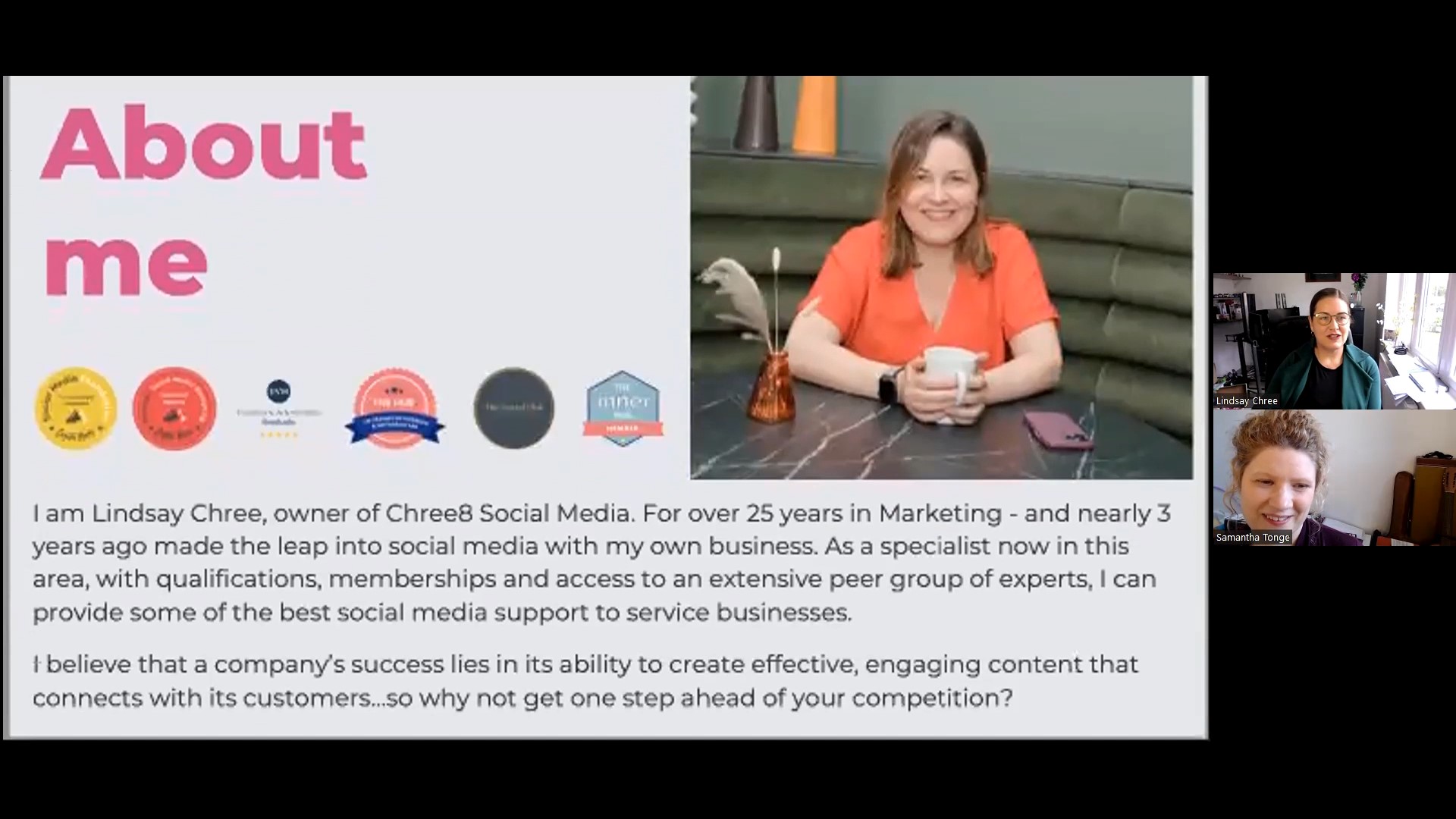
Lindsay Chree: Hi, I'm Lindsay Chree from Chree8 Social Media. I specialise in helping clients of all sizes across the UK work on their social media strategies. I also do training, social ads, do one-to-one training or training with companies in person or on Zoom. Sometimes I do social media management. Mostly I look at the company's strategy, how they're doing, and audit that, and usually hand it over to the client to manage that. I'm in North Berwick but I work with companies across the UK.
Samantha: Brilliant. Thank you. I've yet to come across a client who doesn't need to use social media as part of their comms and getting that right is incredibly important. So, Lindsay, you're my most prepared interviewee, ever. I believe you have a deck of slides?
Lindsay: Yes, I do. I'm a teacher's pet today. But actually, I already had these slides. So, I did cheat a little bit. It's quite a good framework to go through with clients on strategy, generally.
So, a lot of companies, they come to me for social media advice, and either they're just looking to review what they currently do or they're looking to start from scratch. And sometimes they just focus on social media. But usually, it's as part of a wider marketing plan. You're really looking at quality communications and making connections with your customers.
And this is the most interactive area of marketing where you can get that feedback directly, you can make connections, and you can really get to connect really closely with your customers.
So, this is the kind of framework I look at with customers:
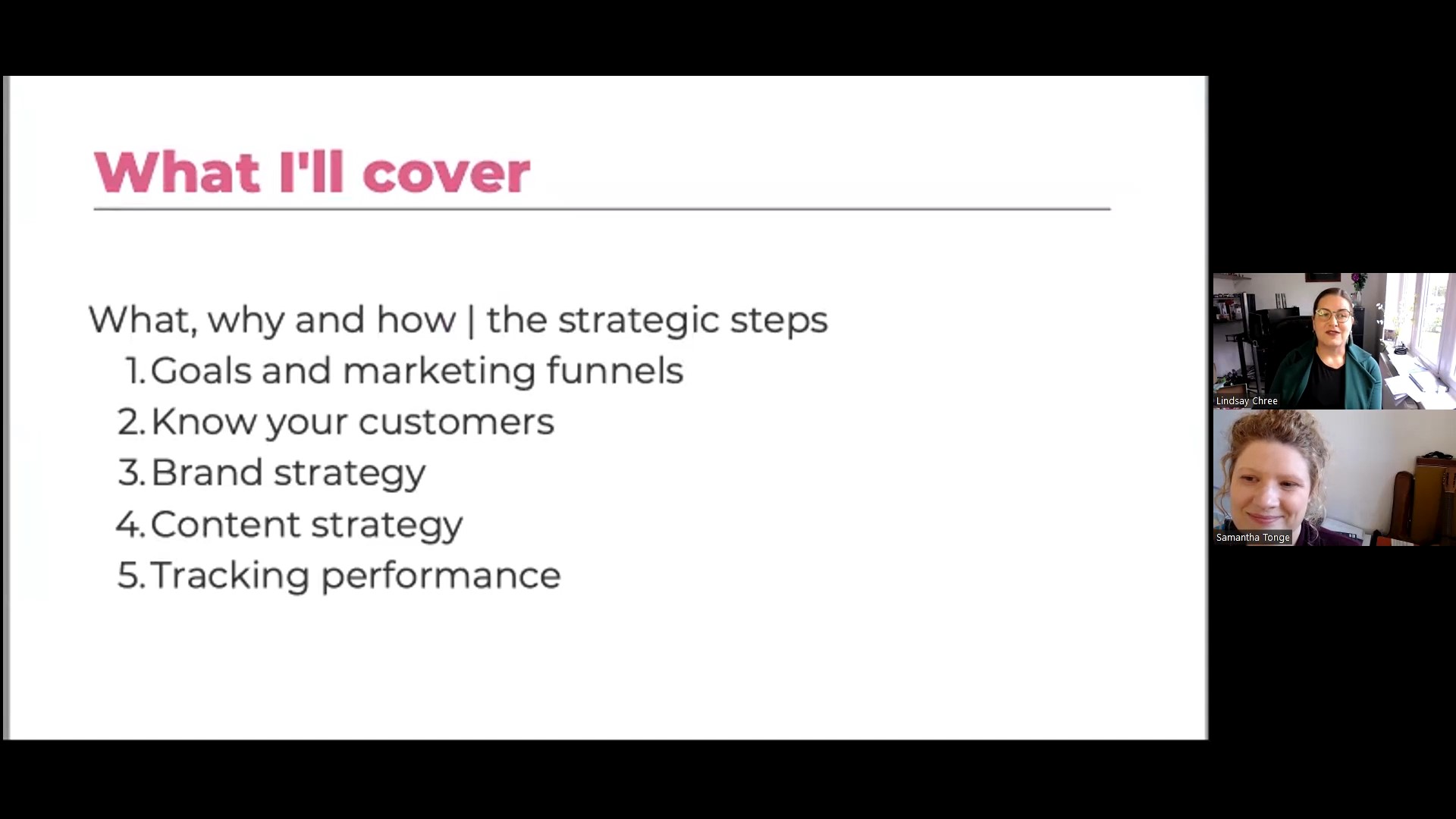
I really encourage customers to look at their goals, specific goals, for marketing, and how that feeds into their social media goals. Which very much requires knowing your customers and your customer segments and building out the personas, as you well know, in your area. Looking at the brand strategy, and how that fits in with social media, looking at your specific content strategy on different platforms, and the different platforms will have different strategies. That's the idea.
A lot of people take the easy route, and just cut and paste. But that's not the best way to make use of it. And then, in all areas of marketing, but especially in digital, tracking performance is really important, because things just change in different times and with the customers and you just need to get to know your particular customer. And the only way to do that is testing. And sometimes things work for some customers and not for others. And you just need to keep trying different things.
I think I've already covered a little bit of a description of me, so, just a few of my qualifications and memberships I'm part of just to keep really up-to-date.
My services:
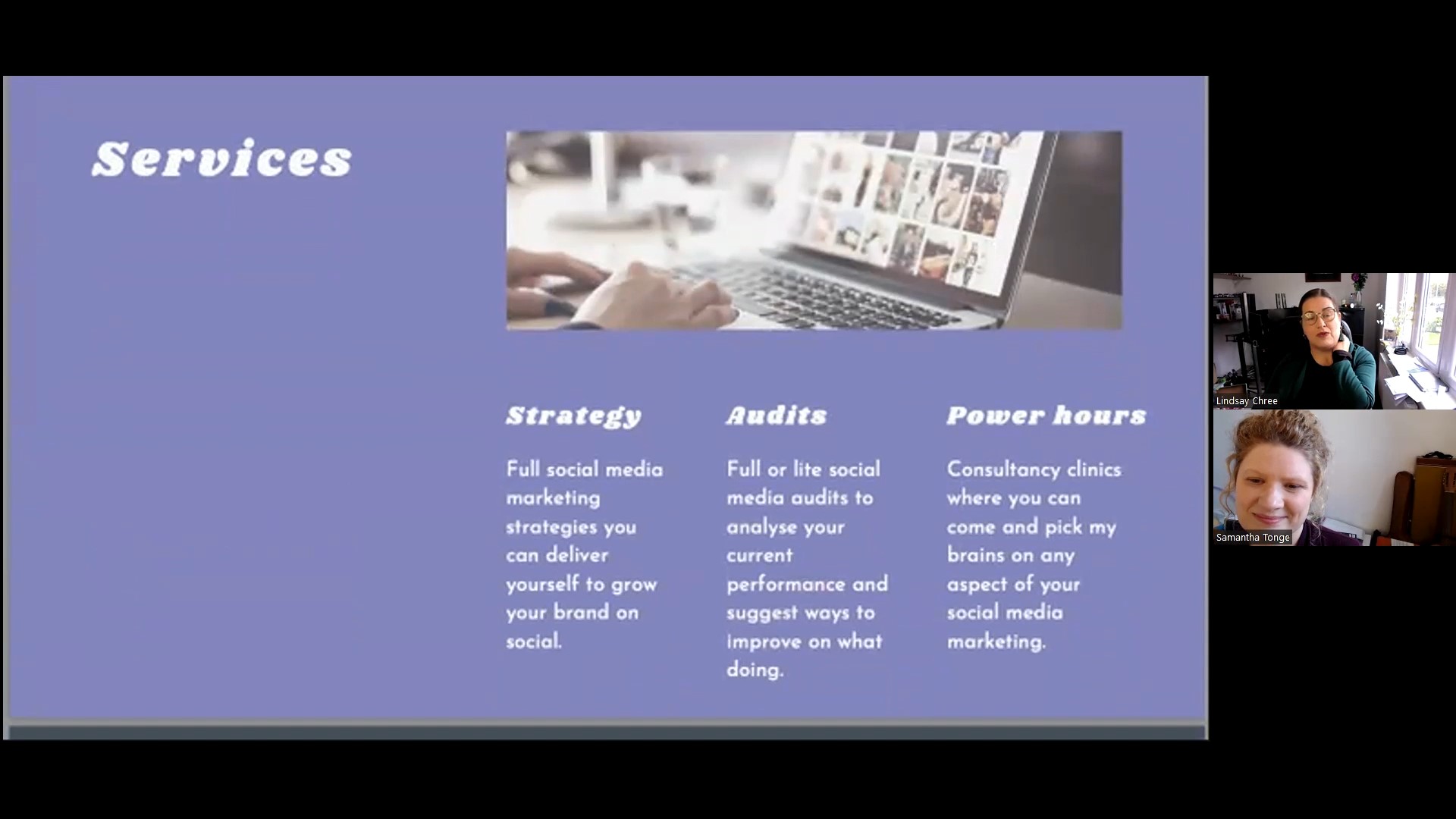
Strategy, Audits, and I do Power Hours. I don't think I mentioned that where if you just got a particular problem with one aspect of social media you can just put in for an hour, we go through that, get that sorted out on the call.
So yeah, the first step: goals and marketing funnels. In marketing you're really familiar with the funnel. But it really does still apply in social media. So, also people coming into your channels will be at lots of different stages.
Or they'll not know who you are, though already know you, but they're trying to get familiar with you and start talking to you via likes and comments and just general engagement that’s your relationship part and then the results part is really if you want them, you know, something to happen as a result of your social media. A lot of it is, and should be brand awareness, your customers getting to know you and connecting. There is obviously an element of positioning yourself for sales and get them to come to your website.
Samantha: As with all marketing communications, you've got to get that balance right between your lead generation and your brand awareness.
Lindsay: A lot of people, they go either way, they sell too much on social media, or they don't sell at all, because they don't think they should. But you have to sell, you know, if you've got an event you're running, and alsoyou sell more than you're comfortable with, as well, on social media. You're kind of thinking: "Oh, I said that three weeks ago, and maybe I shouldn't say it again", but you should keep saying it, keep saying it, keep saying it, in different places and different formats across the board. So people know what's happening, because they will scroll through, they'll maybe have a bit in the back of their mind, that they've seen it, but they're: "Oh, I didn't get the details." And the third, fourth, fifth time, you've seen it, they might make a note of the details or take some action. So, it's not bad to sell and it’s not bad to repeat yourself quite a lot.
This is just a visual description of how that happens:
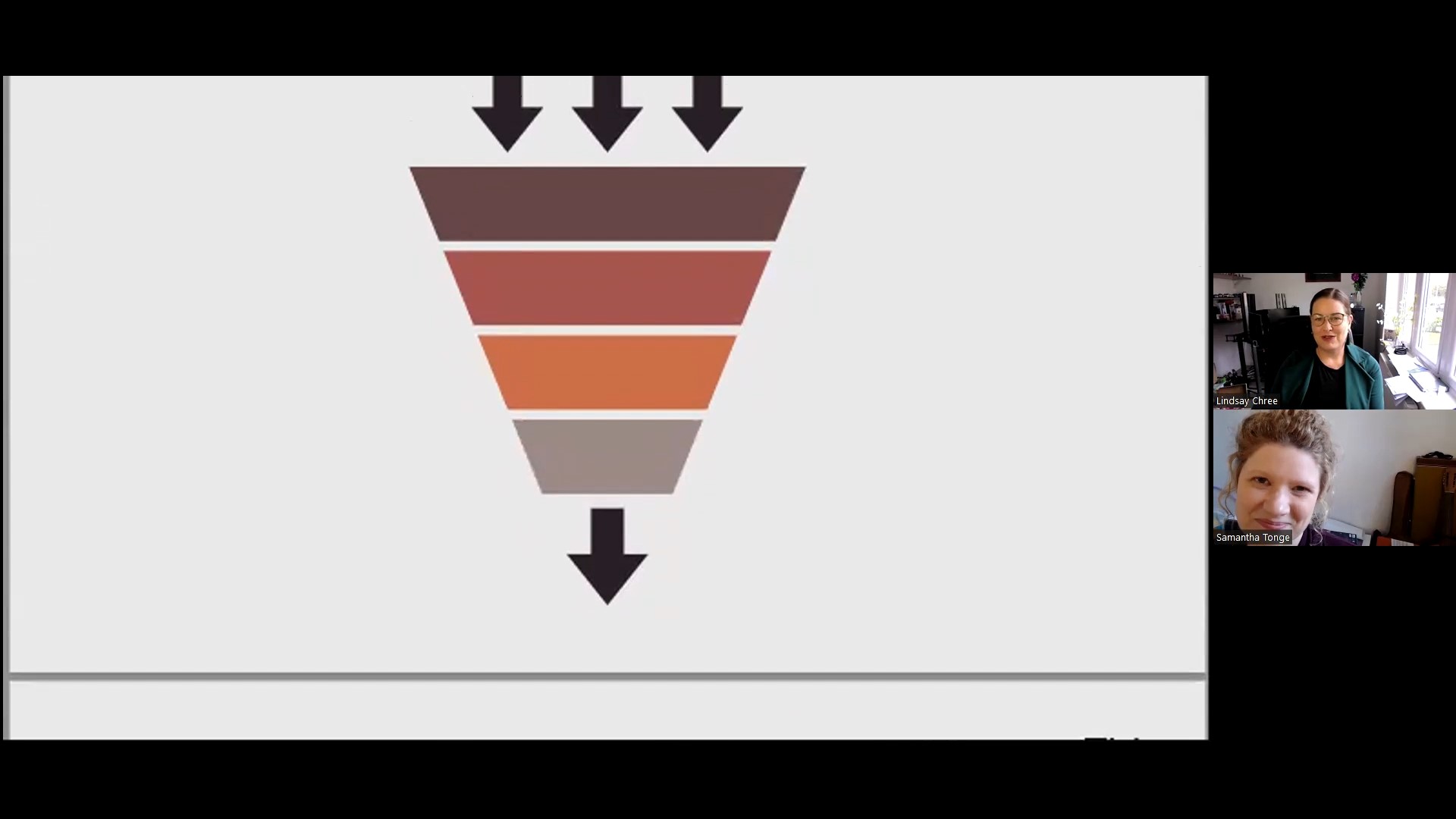
And a lot of new customers will not buy, they'll just see. So, the ones who buy are in the bottom there. But they might buy in even a year's time.
Samantha: Hence, it's so important to do the brand awareness as well as the lead generation. It's not just the customers registered to buy now you've got to think about the future.
Lindsay: Absolutely. Keep the funnel going. Absolutely.
So just a wee bit more on that:
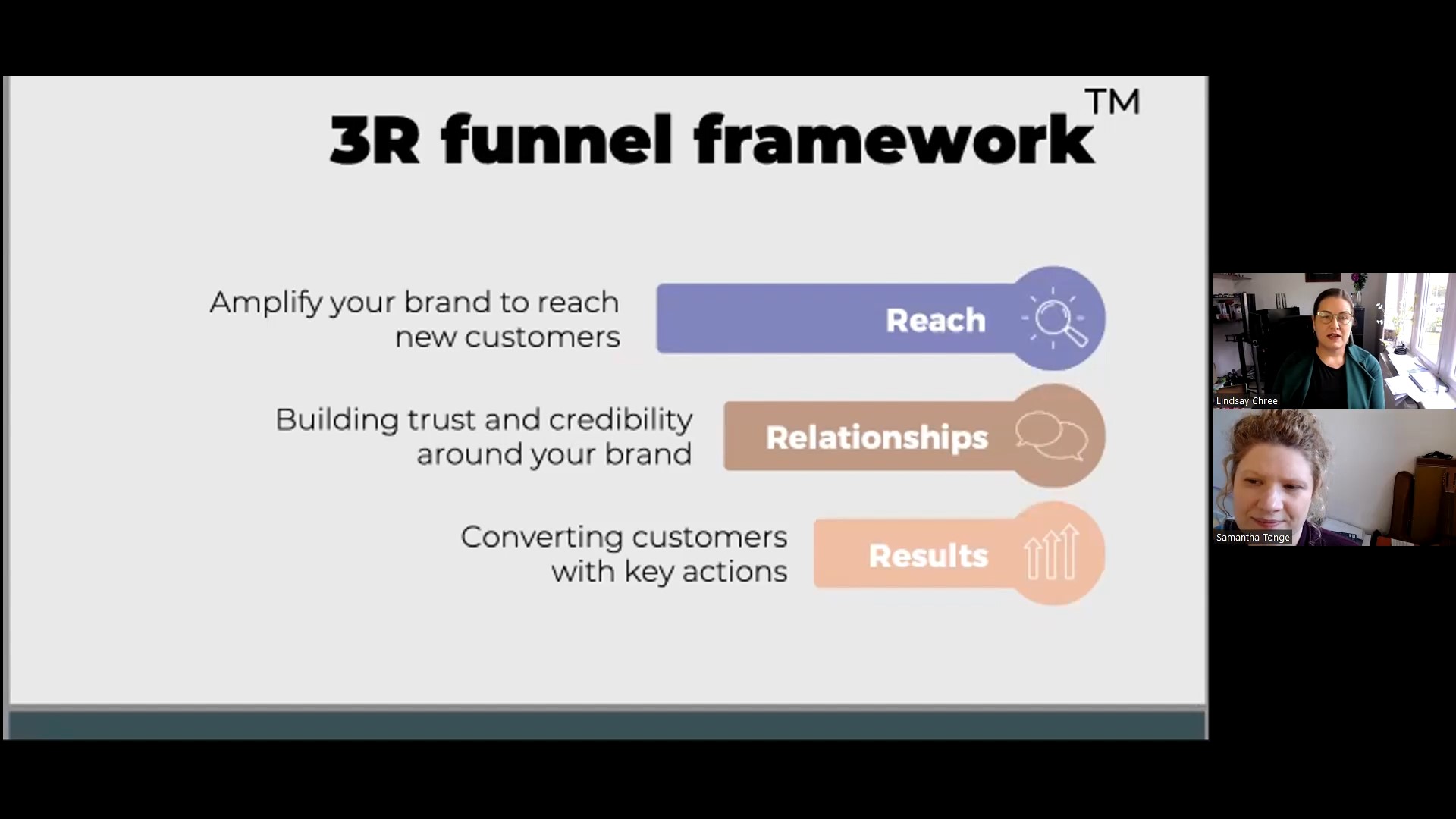
It's a very simple framework, but it does focus your mind on every single bit of content you have will have one of these objectives, really, and some of them are more suitable for others. So, "Reach" obviously is amplifying your brand. And the other one is where people got into the stage of trusting you and looking out for your content. You know yourself, if you got, for instance, Instagram people you follow, you're actually looking for them, aren't you? You want to see what they're saying next, and even on LinkedIn people will be looking for that credible person who they know that are very useful in their content. So that's where that "Relationship" area is. And depending on the channel, LinkedIn is notorious for people don't really engage very much. But people will eventually start commenting, or even if they don't, they might just even jump straight to the "Results".
Samantha: Yes. That happens all the time. You go to events, you meet people, and they say: "Oh, I love your LinkedIn." And sometimes they're not even connected. They're just connected to people you're connected with. And they've certainly never interacted, so you don't know who is seeing your content.
Lindsay: Yeah, and they come straight into your DMs and: "I've been following you for a year." "Don't even know who you are." And so yeah, LinkedIn is really notorious for lurkers. So if you're not getting that relationship stuff, just keep trying. But it doesn't mean that you're not being successful.
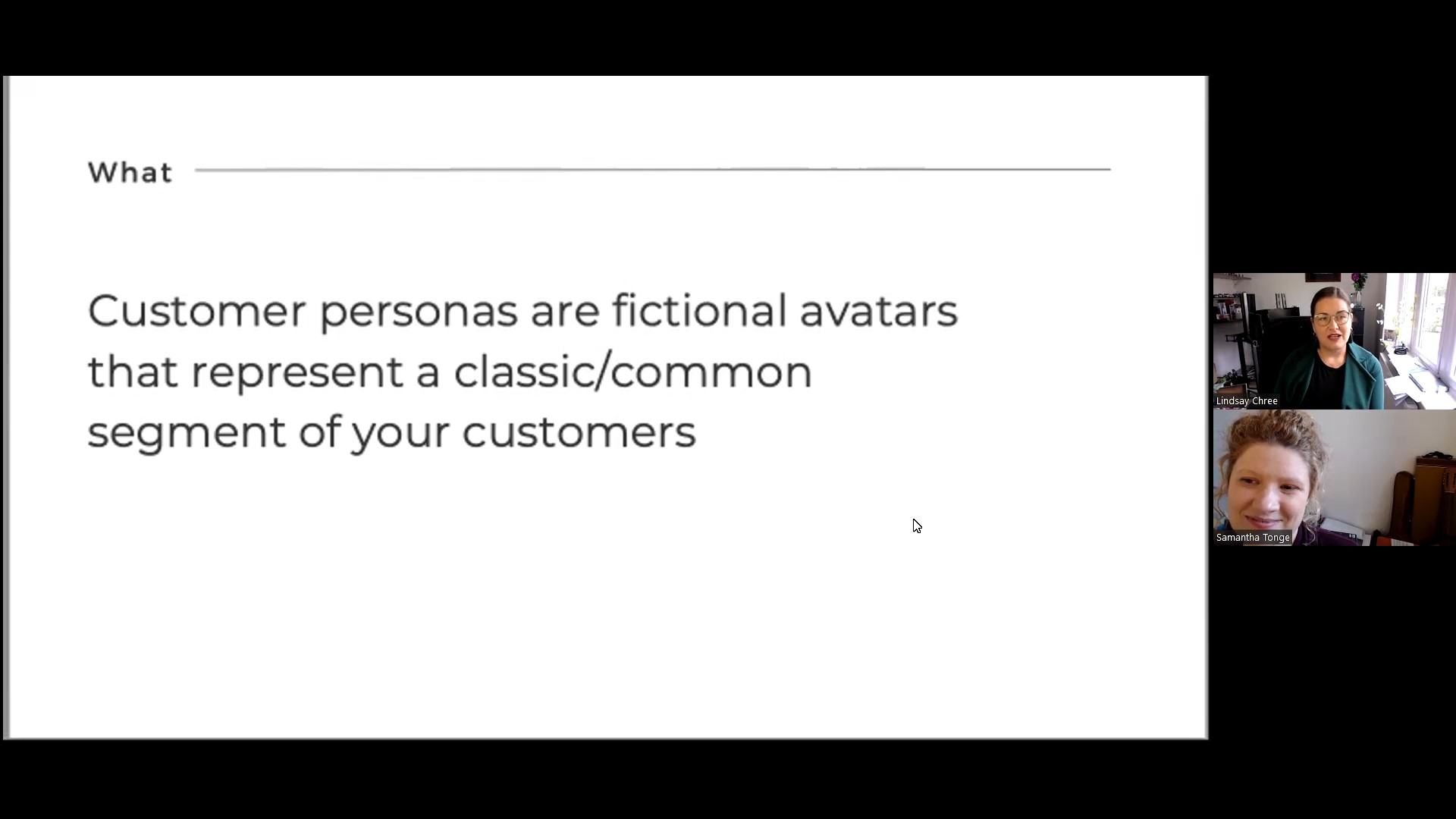
So, this is a part about "Know your customers":
Samantha: That's so key in terms of not just what you're putting on social media, but which social media channels you need to be concentrating on.
Lindsay: Absolutely. You might find that Instagram is a place where you sell B2C stuff, it's more of a Consumer place. And then you might go to, back to LinkedIn, if you've got Business-to-Business clients. You know, they might be quite defined like that, you can do that.
Samantha: And it might need to be on both, especially if you've got employer branding to think about. You've got to think about where potential employees are, as well as your customers.
Lindsay: Yes. So much more so now on LinkedIn it's about the internal branding, isn't it? Employees are, rightly so, more discerning about where they go and work. So, they're looking for your brand, in terms of how you treat your employees. Absolutely, that's on LinkedIn very much. So, when I do the personas, I really build them out so you have a picture of them, you know what they do, you know what they wear, when they have their breakfast and that. You build out when would they look at the social media realistically, and then that's when you can think about the times that you post. So, you're getting that engagement straightaway, because that's the algorithms really like that when you're posting.
So, there are different ways of calling it: "personas, avatars, buyer personas". If you don't know your customer, you can't market to them, you just can't, because if you target everyone, you're targeting no one. It is a quite commonly said, but it really is true. If we just blanket talking to everyone there's no niching or no messaging for them, really, they're not going to listen because they're not being talked to.
Samantha: You can't speak their language, if you don't have a specific type of person you're speaking to.
Lindsay: If you're trying to talk to like a teenager, the same way you're trying to talk to a 50-year old exec, neither of them are going to listen, they're just going to say: "That's not for me, is it?" So, you do really have to home in on that, on those specifics. And that would be demographics, psychographics. Like: "How do they...? What are their pain points? What are their fears? What emotional things can you speak to them on?" Those are the gold dust for marketing, isn't it?
Samantha: Absolutely. And that includes B2B. I think a lot of people think: "Oh, yeah, that works in B2C, it doesn't work in B2B." And it absolutely does work in B2B.
Lindsay: Definitely. Everyone's people. We are all people, aren't we?
Samantha: Absolutely. Human beings, and they have pain points at work, in the workplace that they need to solve and that is an emotional thing.
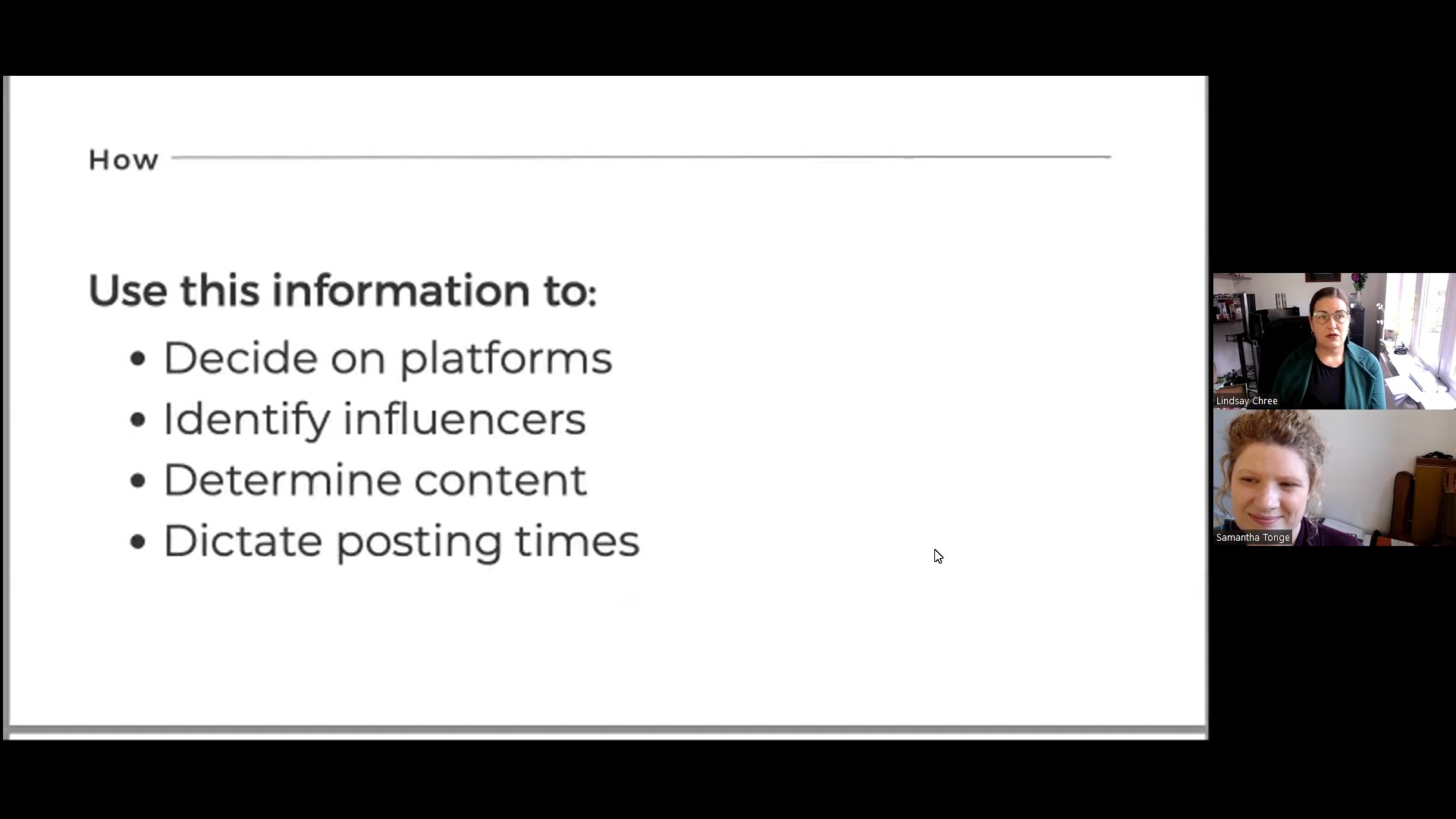
Lindsay: They're people they're not just robots. Sometimes they're going to be more entertained and more attracted to you, if it's a good quality thing, it's all about attracting people. So, when you have that information that can allow you to, as you said before, definitely decide on the platforms you're using for them, it can help you identify what kind of influencers you're going to chime with. So again, if you're looking at the youth market, you're going to have specific influencers, who they're really interested in. And that helps determine the content. And that helps dictate the posting time as well, like I said.
Samantha: I think we need to mention that by influencers, we don't necessarily mean the Kardashians.
Lindsay: No, it's a much wider sphere that you would want to be attracting there...
Samantha: It's not just about people who try and get free ice creams and free hotel space. It's those who genuinely influence the market and are interested in your product and service. And it's just as much a thing in B2B as it is in B2C.
Lindsay: Definitely. LinkedIn are getting a lot more influencers in their field. And if you connect with really active people and decision makers the LinkedIn knows that and their algorithm will reward you for that. More influential people as connections and interactions on the platforms are going to be good for your profile.
So, multiple benefits...
The right brand strategy:
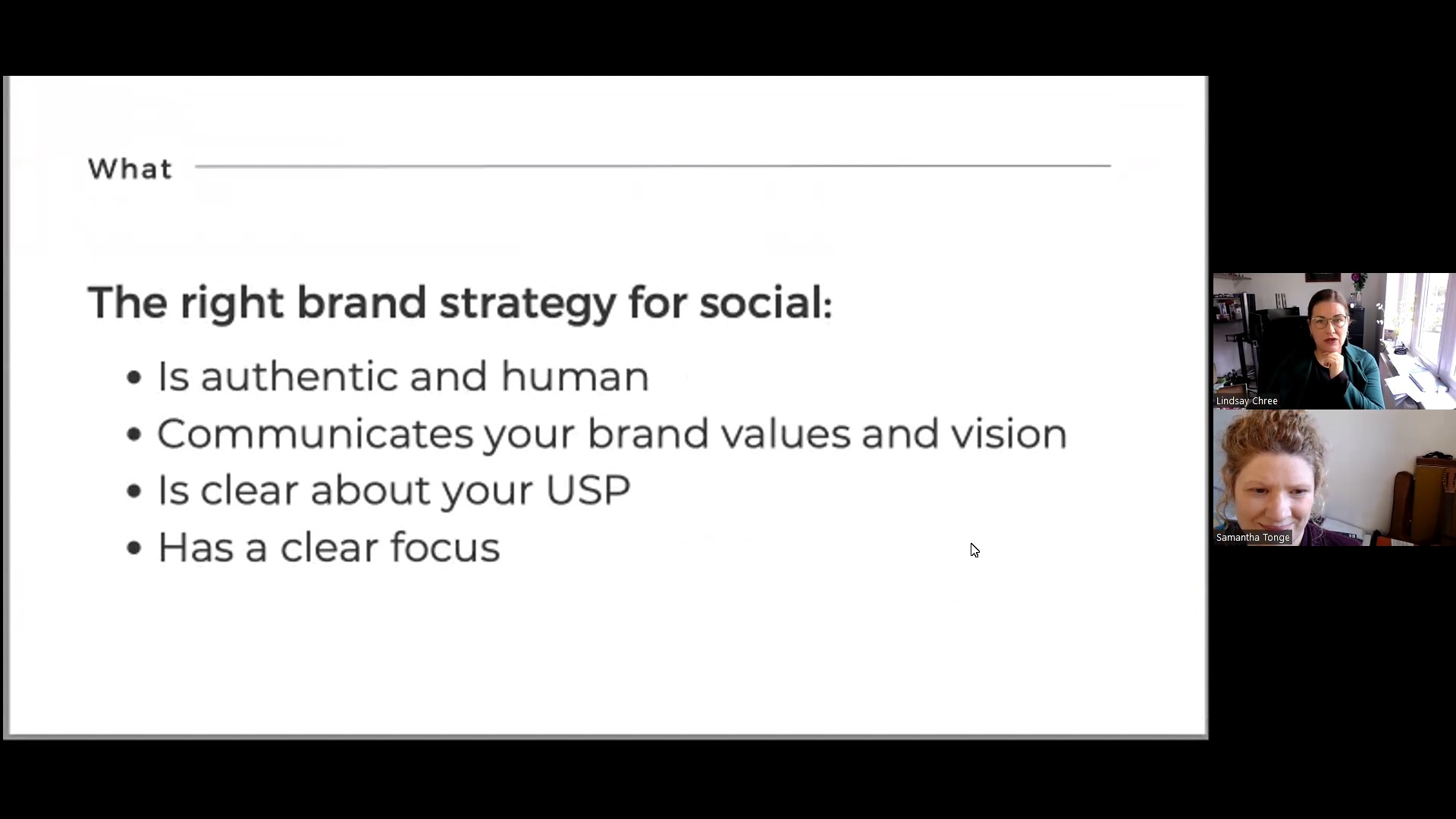
It's not just about colours and forms. A brand strategy for social is about being authentic, human, communicating your brand values, and being really clear on your USP, and have a clear focus on what you're trying to communicate, your messaging, back to your marketing goals and your business goals.
Samantha: Yes, and you have to understand what your brand is and what you stand for, in order to do that on social media, just like anywhere else.
Lindsay: Yes, it's coming from that core. This is the communication channel, but what's the core of the business? What's the core of the marketing goals? What's the messaging? All this is coming from the same place, but this is just a different avenue and having a social brand here and having a particular niche that you're talking to, developing your credibility, relationships and then results, but not only what you want to push out, but what the customers also want to hear about. It's about hitting that sweet spot.
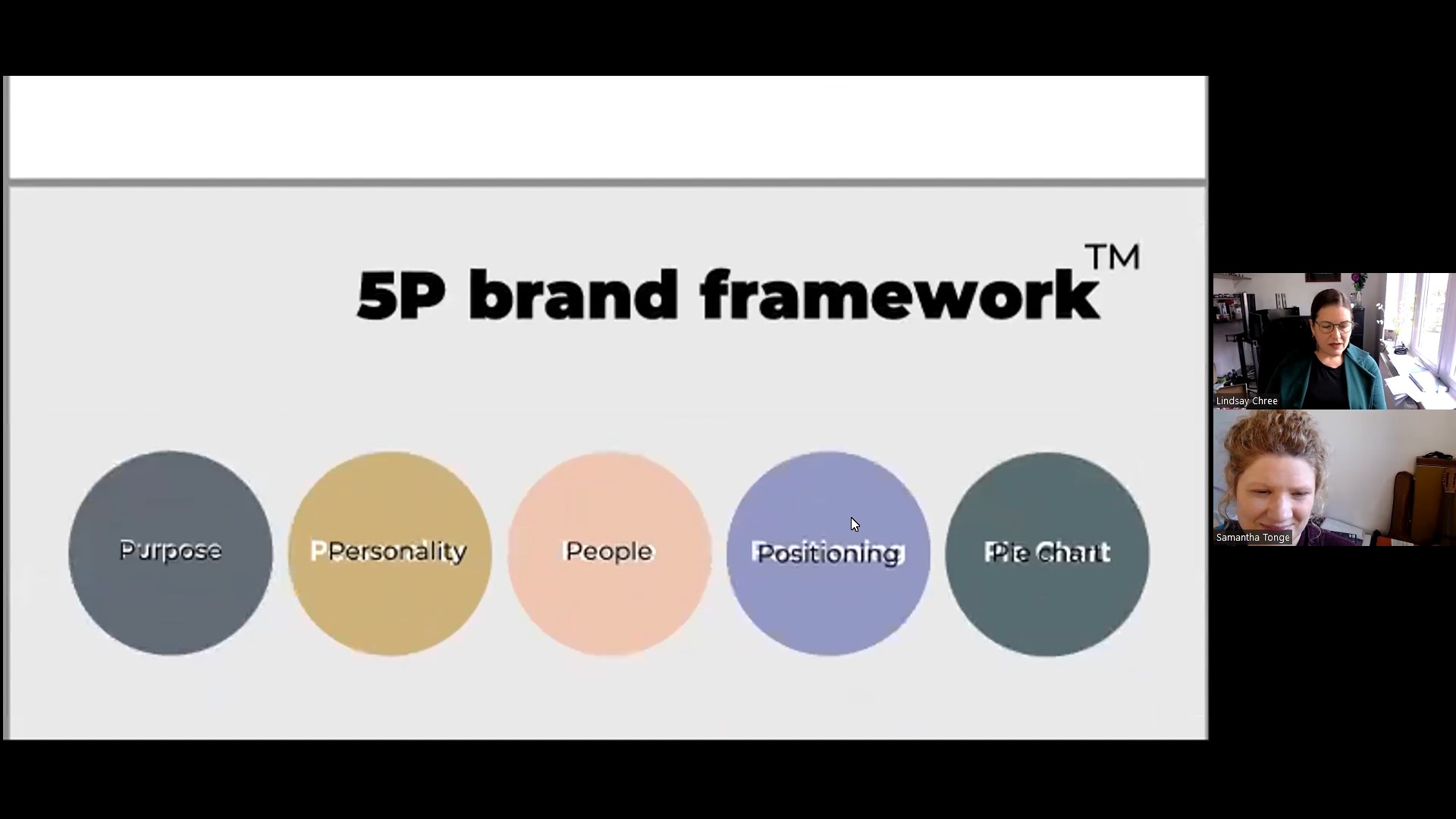
I have a five P's for brand framework:
- Purpose: What does your brand stand for?"
- Personality: Your brand has got to have a personality. You have to display a form of personality; you’ve got to be a little bit vulnerable. I'm not talking about oversharing you've got your boundaries, but you do need to give something away that people can connect with. Otherwise, you're in danger of being a little bit boring and just blending in.
- People: Images of people. They're always going to be those people in the company, if that's you. And that's another element of branding.
- Positioning: Communicate your USP clearly and what solutions you provide for the customers. "Why is that unique?" If there's a niche, are you standing out from the other people that do the same thing as you?
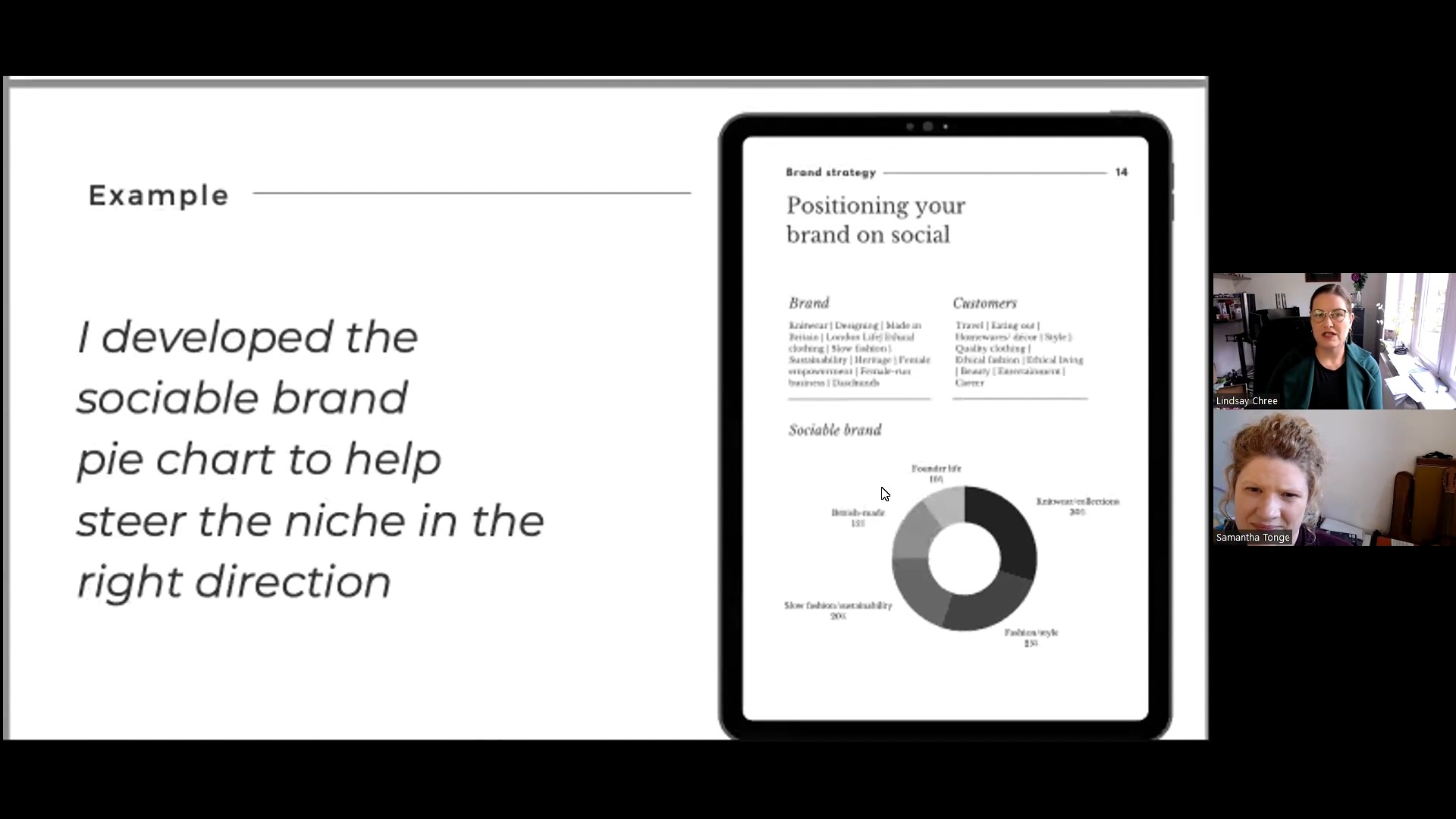
- Pie Chart: here are references content pillars in a pie chart format. You made 20%, you talk about this, 12% represents this, that type of thing.
Lindsay: This is what I referenced earlier, assuring that you're the perfect balance of what you stand for. But you're not just pushing it on customers, you're listening to what they want to hear. And you should do this combination of things.
Samantha: It's not just “buy my stuff”, it's providing things that are actually useful and valuable. And potentially entertaining.
Lindsay: Yes, and don’t have ten different things that a customer is just bamboozled by. Instead of throwing your jargon at them, say: "I understand, they don't really understand that. Let's talk in a manner they do understand." It's just being empathetic to your customer, understanding them, because that's who you're in service of: the customers. But you do have your own agenda, so you have to communicate. It's getting the balance.
So, this is another visual of what can I do for clients into this pie chart.
Then having a compelling content strategy. A detailed plan on how you use your social media content to meet the goals and address the customer needs. Your strategy would have a combination of "What stage of the funnel is it? What's the purpose of it? Wat's the content? What's the topics? And what format would do those jobs?" And also, you're obviously within the platform mix. "What's the right platform?".
Going back to the funnels and the different platforms there's obviously different stages of a funnel.
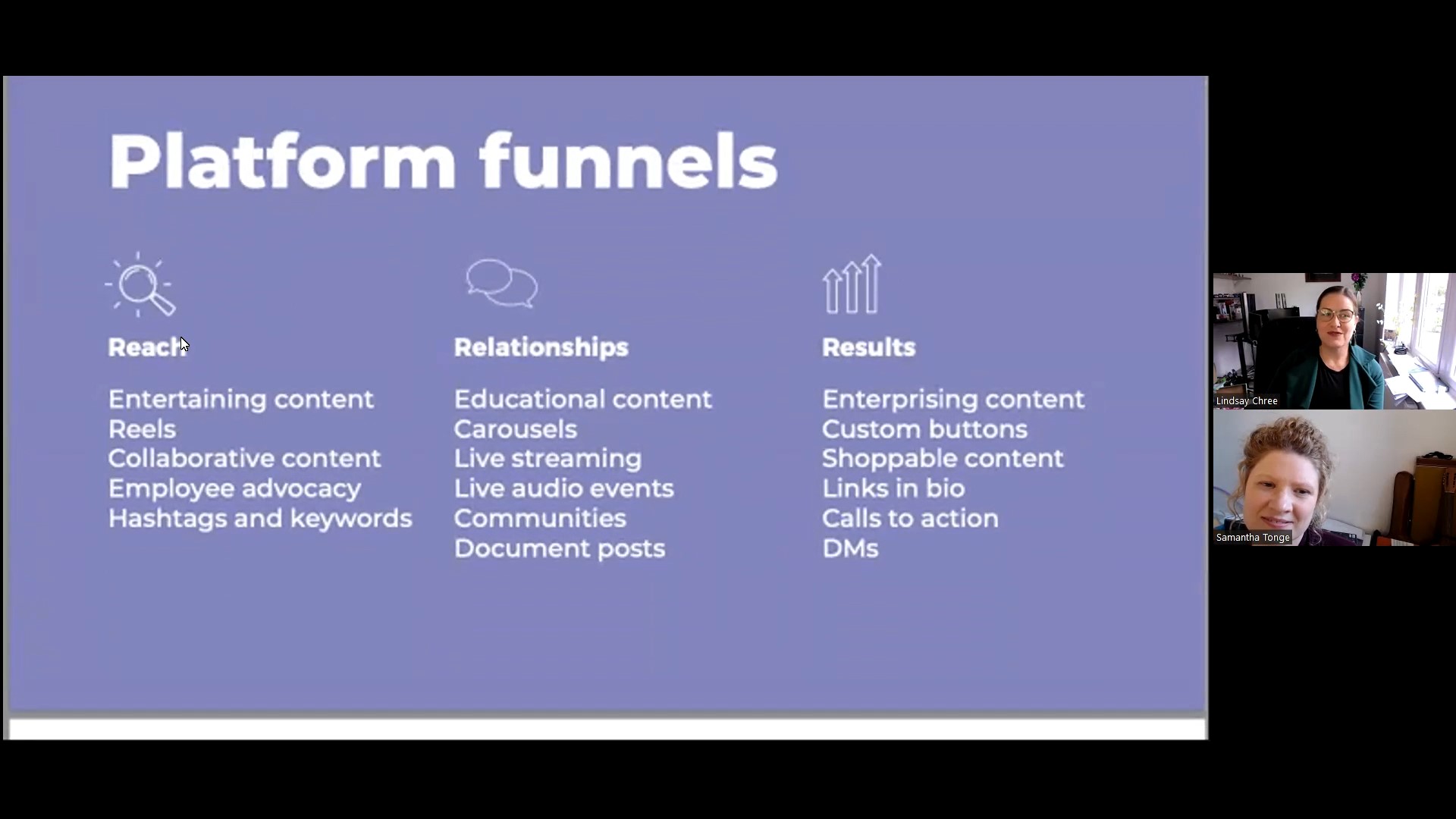
Reach: you want to be entertaining, pulling in new people by grabbing their attention. Reels in Instagram for example do a good job with that, because it does get fed out to non-followers, more than anything else in Instagram.
Collaborative content, that pulls in followers of the person you're collaborating as well. So that's a good way of reaching.
Employee advocacy, like we said before about employees being the brand. Are they satisfied working in the company? That's another thing to reach other employees.
And then the hashtags and the keywords are important on social media because some people are choosing to not search on Google anymore. They're moving to searching within platforms such as TikTok and Instagram.
Relationships, when you're in the middle of the funnel, you want to do more education, do carousels where people can have learning much more, maybe quick tips and things like that, live streaming audio events. You're building communities, you're not just attracting their attention, you're wanting them to learn things from you, get to know you, trust you, start coming back to you more and more for your content.
And then Results content would be: "This is what I've got to sell" and why. The buttons for users to go directly to your website, where you want to take them off the platform and get them to do other things. Different Calls to action and then the DMs, that's where a lot of work in sales really happens in LinkedIn.
It's just a handful of examples, but hopefully it brings it to life a bit more. You need to be thinking about this when you're planning your content. What tactics you're going to use on each of the platforms and making sure there's a good share of Reach, Relationships and Results content.
Reach, the feedback you're getting from customers is that they are liking you, they're following you that's the engagement rate. And the Relationship part, whether it be the sharing, liking, saving, commenting. And then Results refer social referral, social proof. The buttons, their clicking, you can measure all that. And then, you know, leads that are coming in directly from DMs.
Samantha: And remember if someone phones you out of the blue, and it's a lead, ask where it's come from. I've certainly found in a few cases. "Oh, I found you through LinkedIn." And until then I didn't know them from Adam.
Lindsay: That's true. You get all fancy and put in particular trackable links, can't you? But at the end of the day, you just ask them and you'll know.
And another thing - entertaining, emotive, it's good for awareness, educational, good for building credibility, enterprising is good for promoting your services. You want to get a mixture of all these things as well.
So, there's lots of things to think about. But you want to entertain them, educate them, and ultimately sell to them, not in a pushy way, as you know, but giving them things. You maybe give them a lead magnet or upselling again and again. That's the reason why a lot of people are on social media as well, to keep their business going.
So, you have to get a good mixture. And that’s what I do for clients. I break down every single platform for them, and it wouldn't be a cut and paste, it'd be very different for each platform. Each platform would have different tactics for Reach, Relationships, and Results.
And finally, really, you're tracking performance. So obviously, these things are all just about testing, measuring, refining, just keep going round this loop. Just going testing things, testing the format, the time of day. "Is it going to be a video, or an image, or a graphic, or an infographic, carousel?", "Does the photograph have people in it? I'd steer clear of stock images, personally, but sometimes you have to, but people just generally relate a lot better to the real people in the business. So, it’s just constantly refining, testing, measuring, reflecting, refining, testing, measuring. Once you've got the results, it's not going to give you the answers. You obviously have to look at what you did well, and just keep doing that process, really.
Samantha: And don't base it on one individual post, either. You need to look at a broader number of posts because there's always an element of luck of the draw, as well as the content, the time. Because if the right person sees a post, it'll do really well if, for whatever reason, most of your target audience doesn't happen to be on that particular day. That particular post might not do well, but it wasn't anything to do with the post itself.
Lindsay: Exactly. You think: "Oh, this month, the photos have done well, but next month, the photos didn't do well, but the videos have done well.". It has to be an element of what you enjoy doing as well. If you absolutely hate video it's got to be realistic in terms of your time and what you like doing.
Photos of yourself will do well. I would always just be trying those things. And if you initially don't like them, you will potentially get more comfortable with them.
Samantha: I can speak from personal experience on that one. I actually hate having my photo taken. I wasn't very comfortable when I first started doing videos, but I'm getting more and more used to it. And well, certainly the video interviews, I've been doing there for a few years now. So, I'm completely comfortable with this. That's how it kinda started, doing videos and putting myself out there, especially for a small business like mine, where, I'm the Managing Director, I am the face of the business. Got to do it, really. You have to force yourself.
Lindsay: Do you find it is worth the effort, these videos that you do?
Samantha: Yes, 100%.
Lindsay: You get a lot of inquiries and things from it?
Samantha: I find videos and anything with my face in it, as a general rule, is the best performing content.
Lindsay: That's what I find. You put one picture of the person out, and it just absolutely floods with comments and likes, which can bel a bit frustrating. But it doesn't mean to say that your other content hasn’t been read, looked, absorbed. But people just want to like a picture of you.
Samantha: And people like to buy from people they feel like they know. When you start putting yourself out there in video and images, as an individual, on an individual level, not just the company level, then they feel like they know you.
Lindsay: Yes. In a small team as well, you can get a good rapport in a team. And that comes across really well. You think: "Oh, that's a great team." And you're gonna want to do business with that team, because they seem so friendly. So yeah, I think that really just getting the people involved. Otherwise, you're just a brochure, you're just looking at a moving brochure.
There's so much you can do in social media that's creative and connects. A lot of people forget about the engagement elements. Talking and connecting to people is just as important as posting. So going in and like making connections and talking.
Samantha: Yes, the business development area. And funnily enough, I do have video specifically about this. It is for LinkedIn, but specifically about the business development element of LinkedIn, and building those connections and how you build those connections etc.
Lindsay: And that is really, really important. Because LinkedIn algorithms will really reward you as well, if your comment is really worthwhile, even if you're just making the comment. That of course, goes on to a great post as well, you know, it's actually really good for you. You don't understand how much it reflects on your profile. So that's really important. And making sure you're seen and what do you think about that, or is the experience you've got. You're not always gonna get the answer. And you might get radio silence, but just be prepared for that. And just, you know, but sometimes people just go: "Oh, well, that's fine. Great. That's really useful.", and they just walk away. But they don't realise that you want the comments and it's not like in every engagement post you're going: "Please can you reply? People, do this." But if you encourage a bit of comment, and you tell your audience that that's what you want, then they're much more likely to do it. So you want to say: "like this, if you can relate". The polls are always brilliant, I know that people maybe getting a bit tired of them now, but I do love LinkedIn polls.
Samantha: And with a poll you have at least two pieces of content: the poll, and then you can do a post about the results, if that's interesting.
Lindsay: Absolutely. Make use of that feedback. Like I said, it is genuine customer feedback you're getting. If you don't know what to do for a sort of LinkedIn live event, I'd be thinking: "Right, I'll just poll up and see what people want to hear." It's really useful as well as you know, getting an engagement and hearing from people. And if you can get them not just to vote in the poll, but actually say something as well, then you get to gather the debate on the topic as well. It's really useful. And on Instagram, as well, you know, on Stories, there's loads of little engagement buttons and things that you know, is PR and, if you're scrolling through, can't resist it, you press the button, you know, it's so easy. And then that just kind of pulls people more into your world.
Lindsay: So that was the end of our presentation.
Samantha: That was fantastic. Thank you very much. So do you find that it's not just necessarily small businesses that need this sort of help, but actually, big businesses need help to go in and actually look more in detail at that, specifically at the social media strategy?
Lindsay: Yeah, I think there's two different strands. Small businesses, they need a helping hand to do it themselves, because realistically they may not have the budget for a salesperson to do it. So, I would help them either with a power hour, or just do an audit, or sometimes if it's a slightly bigger personal business, then I might do a strategy. And then maybe I'd follow up with a little bit of coaching after that.
And then the much bigger businesses, they are either doing nothing, or they don't know what they're doing, if it's right or wrong, or they're just trying to do absolutely everything, they've been on every platform, and they're just absolutely burning out. Because: "What's the point?" Some of them, they don't need to be on TikTok, they don't need to be on... you know, certain ones really don't need to be on Instagram. You can just pick the platforms that are most relevant to you.
You know, some of them will have maybe a... maybe get an intern or a marketing assistant or an exec or someone. They may not have the knowledge, this sort of specialist knowledge, so they then need my help. They know about digital marketing, and they're very enthusiastic and they're probably full of ideas. But there's still quite a lot to know about it.
Samantha: They need that guidance.
And I guess for some very small businesses, with very little in the way of marketing budget, the majority of what they're doing is social media.
Lindsay: Yeah. A lot of digital marketing channels are free, you know, doing SEO. Not so much then advertising, obviously. But the biggest chunk, that's free, I suppose you've got your content marketing, as well, don't you? You're writing your own blogs on your website, and all of that is free. But this is probably the quickest way, I would say. And once you've stepped back and done the strategy, then you're good to go. It's probably, for me, the quickest way.
Samantha: And if you're creating content, your blogs etc. and you're getting your website; the quickest way to get those links out there for people to become interested is social media, especially for a really small business.
Lindsay: I think it used to be websites people went to, but I think more so now, you just go straight to their social media platforms, because websites... probably guilty of this myself, you know, you put the website up, you think you've got everything in there and you kind of walk away. Unless you're doing a blog, it can be quite static, but...
Samantha: Oh, yes. Yes. I know that's not social media in itself, but that is something that if you've done that: "Don't. Please." And if you're creating content for social media, you've probably got blogs that you can start putting on there and make sure it's not static.
Lindsay: I know, I'm probably the worst for that at the moment. But yeah, absolutely. And when you come to people's website, they're usually out of date, aren't they? And you just kind of think: "Well, that's out of date. They don't have the What's Going On. They don't really have..." Some of them have Feeds in from, you know, the channels. And, you know, the news can be shockingly out of date. They may as well just go to social media, because that will be up-to-date.
Samantha: Yes. That's very true. I mean, it's not that unusual. You go to a company's website and see: "Oh, they've got a blog." And the last article was in 2014, or something.
Lindsay: And you won't be back again, because you think: "Oh, well, that's an out-of-date website." So, you can quite quickly create a bad impression on there. Obviously for social advertising, it's crucial that your website is up-to-date. Because it needs to be really good for mobile. I know that a lot of people do separate landing pages, probably for that very reason that they've come off the ads. But if you're sending them to your website, it needs to be spot on.
Samantha: Absolutely. Get that right first. That brings me onto another point, because, okay, so some businesses are only going to have the budget to do organic social media, which is the non-paid for. But you can only reach people that you're connected to, or people who are connected to people who are engaging with your content. Whereas there are a lot of people out there who you probably want to engage in some way, shape or form. So, if you're creating this great content, ideally, you want to get it out there further, don't you?
Lindsay: Yeah, it's quite shocking actually. On a lot of the platforms like Facebook, Instagram, there's a business page, which it has to be, if you run a business, it will just really feed out to about 2% to 3% of your current followers.
Samantha: Yeah, that's also a very good point.
Lindsay: It is only going to be feeding out to a very small amount of people. So that's the other reason not to be scared of like just repeating yourself, repurposing content. Just take the content you've done two, three weeks ago, put a different image on it, put some different copy on it, just makes a whole lot of people are not going to go: "Oh, yes, Samantha said that a month ago."
Samantha: Yeah, absolutely. I say this all the time to people: "You will get bored of your message long before your customers even start to remember you."
Lindsay: Exactly. And I would still put out pictures from a photoshoot probably a couple of years ago, but I'm so sick of them. But a lot of people have never seen them. So, definitely, don't worry about using it all again. Obviously, the platforms want to make money, so they deliberately restrict their reach so that you'll pay for it.
But don’t do the advertising without the organic, because if somebody is coming through your advertising, and they have a look at your your page or profile and it is really bad, they are going to be like: "No. It needs to be both. And that's frustrating because you just want to get the reach, but you actually have to put the work in as well. So that demonstrating that you are an active company and you're live and you're very current and you're currently talking to your customers, and you're being consistent. If they're finding that you're out of date when they come to your social media, they just give up on you completely. "Nothing's up-to-date, I'll just go somewhere else." So yeah, they might give you that chance of like: "Okay, the website is not up-to-date, I'll give them a second chance of going on social media", or the other way around. But they won't give you like a third chance, you know?
Samantha: Excellent. Thank you so much.
Lindsay: All right. No bother at all. Been lovely speaking to you.
Samantha: You too. And before we go, anything you want to plug?
Lindsay: If people come through your website, I could do some sort of discount, like maybe a 10% discount or something.
Samantha: Oh, wow. Awesome. I will put your link on the website when this goes up. If you are watching this on YouTube, go to my website. It will be there.
If you need help with your Social Media Strategy, contact Lindsay at lindsay@chree8.com, on her LinkedIn or via her website. If you need any other marketing help for your engineering company, contact me on 07791 521439 or email me at samantha@labrakita.co.uk